
Don’t get in a farmer’s way during harvest. Nothing stops him from doing whatever’s necessary to keep his equipment running. He devours his meals on the go, while metal teeth devour the crop. Combine fires and overturned machinery can make things scary in a hurry.
Jesus describes the final harvest with no less intensity: “I will say to the reapers, ‘First gather together the tares and bind them in bundles to burn them, but gather the wheat into my barn.'” (Matthew 13:30) Don’t get in their way either: “The reapers are the angels.” (Matthew 13:39)
Like a farmer’s harvest itch, the heavenly host hover, ready to get at it: “The Son of Man will send out His angels, and they will gather out of His kingdom all things that offend, and those who practice lawlessness, and will cast them into the furnace of fire.” (Matthew 13:41-42)
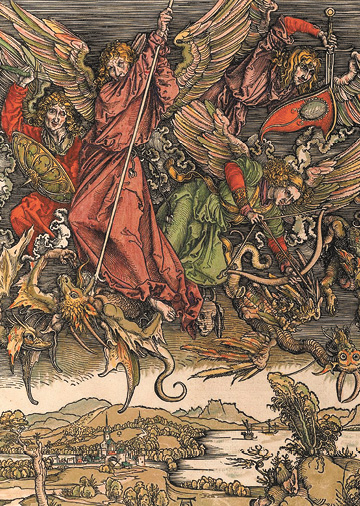
Saint Michael Fighting the Dragon is a woodcut of 1498 by Albrecht Dürer in which he depicts the Archangel Michael leading God’s heavenly army in a battle against the devil, who is represented as a dragon.
By Luther’s day, St. Michaelstag (September 29) was an annual harvest festival, but the holiday was riddled with superstitious fear. Corn-doll angels woven from dried husks were hung like scarecrows to ward off evil. Angels were considered fickle creatures to whom you could pray for good luck, or who would curry favor for you with the stern Judge Jesus.
They had it backwards. We are the ones who deal with one another in an unpredictable manner. It is not the angels, but our own sin which should make the final harvest a day to be feared.
But by calling off the “twelve legions” of angels that might have rescued Him in Gethsemane, the Son of God chose instead to be run over with that divine wrath you and I deserved to see. Because Jesus hung from a cross in your place, His name scares off any and all evil for all who believe. This Gospel “which angels desire to look into,” (1 Peter 1:12) so captivates their gaze that nothing can now get in their way of serving your eternal good.
So Luther repurposed his harvest festival to teach instead “how the Lord uses Michael and the angels to deliver His people.”
No farmer could stand over every stalk of corn, but Jesus can and does, through an innumerable company of angels deployed to watch over each “little one” in His field (Matthew 18:10). Michael and the angels, who banished the demon host from heaven, continue to engage in ceaseless invisible battle to ensure that you get there safely (Revelation 12:7-12). God doesn’t need angels, but just as He provides daily bread through the unsung labors of countless farmers, the Lord God of Sabaoth sends His angels to keep you from unseen harm. Thus, Luther teaches you to pray: “Let Thy holy angel be with me, that the wicked foe may have no power over me.”
If your church doesn’t have a service to remember St. Michael and All Angels, it doesn’t mean you’re doing something wrong. Martin Luther, in advising to continue the observance, was simply seizing upon an already longstanding tradition as a practical opportunity to dispel confusion with saving truth.
But since Scripture so strongly ties the imagery of harvest to the glorious work of the angels, it would serve a modern Christian family well to go for a drive this fall and sing:
For the Lord, our God, shall come
And shall take His harvest home;
From His field shall in that day
All offences purge away;
Give His angels charge at last
In the fire the tares to cast,
But the fruitful ears to store
In His garner evermore.
(TLH 574:3)
The angels are coming. Nothing can stop them. And it’s good news indeed that they’re coming for you!

is pastor of Prince of Peace Lutheran Church in Hecla and Aberdeen, South Dakota, and Redeemer Lutheran Church in Bowdle, South Dakota. He also serves on the CLC Board of Missions.