

In this series we offer brief introductions to the books of the Bible, including background, authorship, content, and application to the lives of today’s Christians.
A magnificent figure in white with a two-edged sword coming out of his mouth (chapter 1); a seven-headed beast rising from the sea (chapter 17); angels duking it out in the heavens (chapter 12)—such is the collection of visions that closes out the New Testament. This epistle, with its bizarre imagery, is often either misinterpreted or left unread. But one must ask, would the Holy Spirit really want people to fear opening the book? To leave it unread? Recall Romans 15:4: “For whatever things were written before were written for our learning, that we through the patience and comfort of the Scriptures might have hope.” (NKJV) It is our prayer that the few thoughts below will help the Bible reader find here exactly what Paul was promising to the Romans: “patience . . . comfort . . . hope.”
Revelation was composed by Jesus’ “servant John.” (1:1) The apostle John is meant here; he was writing from Patmos, an island off the coast of Asia Minor, and addressing a group of seven churches in that region. Most likely it was written near the end of Emperor Diocletian’s reign (A.D. 95). Diocletian was the first Roman emperor to require emperor worship, and that cult of worship was especially strong in Asia Minor. This date is provided by the church father Irenaeus in the mid-second century. Irenaeus was a student of Polycarp, and Polycarp was a student of John himself. That’s a pretty good line of testimony! But the main takeaway is that this writing came at a time when the Church was suffering vicious persecution.
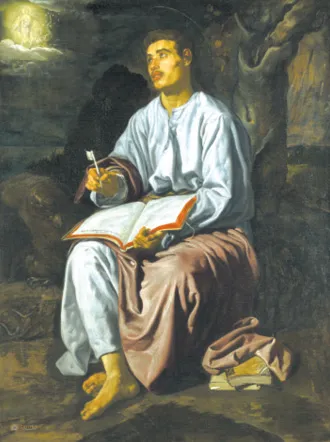
St John on Patmos 1619 by Velazquez
John is clear about his purpose in sharing these visions: “God gave him [these visions] to show to his servants the things that must soon take place.” (1:1) The letter lays out for the churches how things were going to proceed in the coming era. Much of the message was “signified” to the readers. As Jesus said of His own parables, these words are meant for those who have “ears to hear.” (Matthew 13:9) To those who reject Jesus as Lord, this book has little to say (except “God wins.”) Jesus is the key to understanding the message.
Certainly, the most daunting thing to a reader of Revelation is the dramatic imagery that flows throughout the text (for instance, the “locusts from the abyss” in chapter 9.) So, why all the picture language? Why not lecture like Paul? Or convey the truth in simple parables, as Jesus did? Probably because these vivid images and the Bible truths packaged in them impact both the mind and the heart; logic and emotion.
It must be understood that Revelation is not a stand-alone revelation. It is deeply rooted in Old Testament expressions, and in Jesus’ own life and work. It is helpful to realize that there are a handful of themes that run through the book: (1) Christians will indeed live in a world of violence, plagues, and privation (think of the evils spread by the horsemen of chapter 6); (2) during this time, the Gospel and the Church will suffer vicious opposition (see chapters 10, 11, 12); (3) the Church, the whole number of those who are elect in Christ, will ultimately be delivered from this terrible opposition (the 144,000 and the multitude arrayed in white portrayed in chapter 7); and (4) Christ (magnificently portrayed at the start of the book) will prevail as the terminus of all human history, exactly as Paul told the Philippians: “at the name of Jesus, every knee should bow, in heaven and on earth and under the earth.” (2:10) Readers who keep these themes in mind may not be certain of every detail they see, but they will find much comfort as they work through the readings.

is a former pastor who now teaches English at the University of Wisconsin-Stout. He makes his home in Eau Claire, Wisconsin.