
Poet of Morning and Light
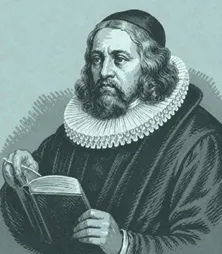
Thomas Hansen Kingo (1634-1703)
Each month we highlight a hymnwriter who authored one or more
of the well-loved hymns that we sing today.
The course of each day teaches valuable spiritual lessons, as David writes in Psalm 19:2, “Day unto day utters speech, and night unto night reveals knowledge.” (NKJV)
The Danish hymnwriter Thomas Kingo was conscious of this and wrote many songs to be used for morning and evening worship. He recognized the reappearance of light each morning as a token of God’s grace, calling His redeemed children to rise and resume their daily activities in thankful and joyful service to Him.
The sun arises now In light and glory,
And gilds the rugged brow of mountains hoary.
Be glad, my soul, and lift Thy voice in singing
To God from earth below, Thy song with joy aglow
And praises ringing. (The Lutheran Hymnal (TLH), 542, stanza 1)
Kingo also recognized that the fading light of evening can bring feelings of insecurity, the need for pardon and protection. The child of God can lie down in peace, praying,
Keep me, Jesus, while I slumber!
From my perils without number,
Shield me, Master, in Thy might,
That, released from sin and sorrow,
I may sing this song tomorrow:
Jesus was my Sun this night. (Hymn: “Softly Now, the Day is Ending”)
Kingo saw the passage of the day as he did because of one particular day. It is the morning of Jesus’ resurrection, after laying down His life for us, that makes the rising of the sun each day a sign of God’s favor. It is the evening of the day of His resurrection, when He appeared to His disciples, that frees us from fear at the close of each day.
He expressed these thoughts in the Easter hymn that is the most familiar and beloved of all his hymns:
Like the golden sun ascending,
Breaking through the gloom of night,
On the earth his glory spending
So that darkness takes to flight,
Thus my Jesus from the grave
And Death’s dismal, dreadful cave
Rose triumphant Easter morning
At the early purple dawning. (TLH, 207:1)
This hymn teaches the foundational Christian truth that Christ’s resurrection is the Father’s public announcement that He accepted His Son’s sacrifice for us; our sins have been taken away, and death no longer has power over us. This precious knowledge gives us comfort and hope for each day until life’s end.
Thou hast died for my transgression,
All my sins on Thee were laid;
Thou hast won for me salvation,
On the cross my debt was paid.
From the grave I shall arise
And shall meet Thee in the skies.
Death itself is transitory;
I shall lift my head in glory. (TLH 207:4)
In addition to the title “Poet of Eastertide,” Kingo was often called the “Singer of Orthodoxy.” He had a gift for expressing the doctrines of Scripture in a devotional spirit. This is evident in his hymns on Baptism and Holy Communion, of which Kingo biographer J.C. Aaberg writes, “We meet in these a Christian who humbly and prayerfully accepts the whole mystery of God.”
He that believes and is baptized
Shall see the Lord’s salvation;
Baptized into the death of Christ,
He is a new creation.
Through Christ’s redemption he shall stand
Among the glorious heavenly band
Of every tribe and nation. (TLH 301:1)
Kingo’s hymns usually end with a call for believers to lift their hearts to God in prayer and thanksgiving. He calls upon Christians who have received the Lord’s Supper to sing,
Break forth, my soul, for joy and say:
What wealth is come to me this day!
My Savior dwells within my heart:
How blest am I! How good Thou art! (TLH 309:2)
May Kingo’s hymns give us a fresh appreciation for the grace of God in Christ that comes to us in the Word and Sacraments.
Like countless grains of sand, Beyond all measure,
And wide as sea and land Is Heaven’s treasure
Of grace which Christ, my Lord, Each day bestoweth,
Which, like refreshing rain,
Into my soul again
Each morning floweth. (TLH 542:2)
is a retired pastor. He lives in Watertown, South Dakota.