
In this series we offer brief introductions to the books of the Bible, including background, authorship, content, and application to the lives of today’s Christians.
Anyone who is related to someone famous usually likes to point that out as their claim to fame! Jude was closely related to the most important person of all history. He was a close relative of Jesus Christ Himself. Yet he doesn’t claim any special authority or importance. He doesn’t even mention it. He introduces himself as “Jude, a servant of Jesus Christ and brother of James.” He is a humble bond servant, or slave, of Jesus Christ, just like the apostles and every other believer.
Matthew 13:55 lists the brothers of Jesus as “James and Joseph and Simon and Judas,” though the word “brother” was sometimes used of close relatives like cousins, rather than of siblings. But not even these close relations believed that Jesus was the Son of God until after He rose from the dead (John 7:5). After the resurrection, however, tradition suggests that all of Jesus’ brothers became very active workers in the church. James became the leader of the church in Jerusalem and wrote the Epistle of James. Jude is said to have become a missionary. The Apostle Paul confirmed that when he wrote, “Do we not have a right to take along a believing wife, even as the rest of the apostles and the brothers of the Lord and Cephas?“ (1 Corinthians 9:5)
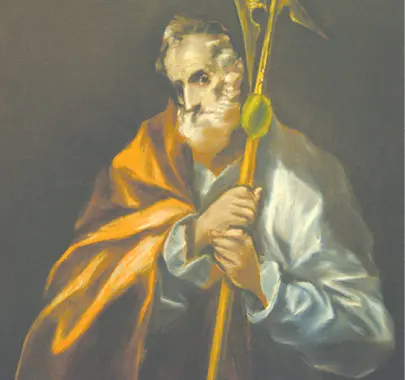
Saint Jude by El Greco
According to tradition, Jude was a missionary who traveled together with Simon–either Simon the Zealot, one of the twelve–or Jude’s own brother Simon. He traveled as far as Persia (present day Iran) where he apparently was martyred. Jude shows he is familiar with the Epistles of Peter and Paul, therefore he must have written sometime after AD 67.
There were many Jews still living in Persia from the Babylonian and Assyrian captivities. His audience seems to have been very familiar with Old Testament events and Jewish tradition. Jude makes mention of some things not found in other books of the Bible, such as the Archangel Michael contending with the devil over the body of Moses, and a pre-flood prophecy of Enoch, the seventh from Adam.
Jude brings a message that is very relevant and necessary in our day, namely, “To contend for the faith that was once for all delivered to the saints. For certain people have crept in unnoticed who long ago were designated for this condemnation, ungodly people, who pervert the grace of our God into sensuality and deny our only Master and Lord, Jesus Christ.” (verses 3-4)
Satan raised up false teachers who twisted and corrupted God’s Word and turned the grace of God into a license to sin. He has a multitude of such teachers today who lead millions astray from the faith. Jude reminds us with many examples from the Old Testament that such actions bring God’s fearful judgment.
Jude closes with a wonderful word of encouragement: “But you, beloved, building yourselves up in your most holy faith and praying in the Holy Spirit, keep yourselves in the love of God, waiting for the mercy of our Lord Jesus Christ that leads to eternal life.” (verses 20-21) While the false teachers are dangerous and to be avoided, Jude urges us to rescue those who have been deceived. “Have mercy on those who doubt; save others by snatching them out of the fire; to others show mercy with fear, hating even the garment stained by the flesh.” (verses 22-23)
Finally, he closes with a very comforting doxology, giving all praise and glory “to him who is able to keep you from stumbling and to present you blameless before the presence of his glory with great joy.” (verse 24)
Read this short, one-chapter book for yourself. It is truly vital for continuing in the faith in our day.

is pastor of Saint Paul Lutheran Church in Vernon, British Columbia.