
Each month we highlight a hymnwriter who authored one or more of the well-loved hymns that we sing today.
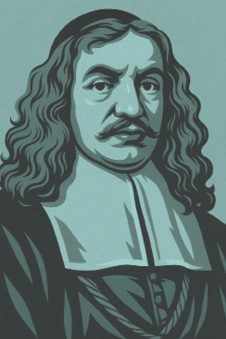
Highly regarded as scholar, musician, and poet, Johann Rist (1607-1667) served in several prominent teaching roles before becoming long-time pastor in Wedel, near Hamburg. Recognizing that he enjoyed a relatively more stable life in northern Germany, Rist dedicated his personal gifts and wealth to comforting those who were directly impacted by the Thirty Years War.
Few Lutheran hymnwriters were presumptuous enough to expect their work to be sung at a church service in their own lifetime. Rist had no intention of replacing the Sunday standards of the few dozen Kernlieder (core hymnody) by Luther and his contemporaries. Rist’s hundreds of hymns were composed for home use, published with musical pointing which encouraged family members to play whatever instruments they owned. This background unlocks a deeper significance to this month’s highlight: “O Living Bread from Heaven.”
The “now” and “here” of our English translation presume you have received the Sacrament just moments prior, but the “jetzt” and “hier” of the original German emphasize a lasting peace by no means restricted to the church building:
Ja mich so reich begabet,
Da ich jetzt fühle Freud' und Rast!

Thou hast so richly honored me
Henceforth I feel joy and rest.
Instead of a liturgical setting, imagine this hymn sung by a family at home—perhaps weeks after the last time anyone received communion—proclaiming its unfading worth. The hymn teaches the Sacrament’s value to children who might not receive it for years to come, or, given the high mortality rate, may never have the privilege. The Sacrament’s institution alone is declared a grace in and of itself:
O wundersame Speise,
O süsser Lebenstrank!
O Lieb'smahl, das ich preise
Mit einem Lobgesang!

O wondrous meal,
O sweet drink of life!
O love-feast I treasure
With this song of praise!
Luther said but one opportunity to eat and drink the body and blood given and shed for you offers sufficient strength to go home content and fall asleep in death whenever God calls. If Holy Baptism suffers no tarnish with time, why would the Lord’s Supper lose its power on the way home, or before next Sunday? This hymn fans that flame by proclaiming an enduring sustenance to these pledges of forgiveness, life and salvation:
Howe'er my course be lengthened,
I now may serve Thee free from fear!
Some of the largest Lutheran synods now advocate weekly communion, as if “the more the better” could compensate for their doctrinal decline. But hymns like Rist’s reveal just how much more time the early Lutherans spent reflecting on the true benefit of the Sacrament than do those in our immediate-gratification culture. In Luther’s day and for some time thereafter, city churches may have offered the Lord’s Supper several times each week, but members weren’t simply ushered forward pew-by-pew. Luther prepared to receive the Sacrament about once a month. J. S. Bach played for thousands of communion services, yet only considered himself personally prepared at most three times per year. They took seriously the mature exercise of attending the Lord’s Supper, bringing a consciousness of sin to this personal encounter with the all-forgiving Savior, with a firm-in-mind resolve to amend going forward:
Grant what I have partaken
May through Thy grace so work in me
That sin be all forsaken
And I may cleave alone to Thee.
The key to a deeper appreciation is certainly not receiving the Sacrament less often, but making more of each opportunity you already have. Include communion hymns in your home devotions. Singing about the enduring sustenance of Christ’s body and blood not only tides you over in faith toward Him and fervent love toward one another, but also builds an appetite for more.

is pastor of Prince of Peace Lutheran Church of Hecla, Zion Evangelical Lutheran Church of Aberdeen, and Redeemer Lutheran Church of Bowdle, South Dakota. He also serves on the CLC Board of Missions.