Anthropologists estimate that, throughout history, people have worshiped over eighteen thousand gods. Histories of ancient cultures mention many of these gods—gods that are the invention of man’s (evil) imagination which, of course, makes them false gods. But there is one God—and only one—Who is real, not a myth, not produced by man. Isaiah 45:5 says, “I am the Lord, and there is no other, besides me there is no God.” This is the Triune God, the Trinity.
The Bible doesn’t use the words triune or trinity, but there are Bible passages that speak of the Trinity. For example, Matthew 3:16-17 mentions the Father, Son, and Holy Spirit at Jesus’ Baptism: “He [Jesus] saw the Spirit of God descending like a dove and coming to rest on him; and behold, a voice from heaven said, ‘This is my beloved Son, with whom I am well pleased.'”
The Apostles’ Creed, Nicene Creed, and Athanasian Creed all summarize scriptural teachings about the Trinity. However, even with these helpful documents, we cannot fully understand “one God in three Persons.”
In A Summary of Christian Doctrine, E. Koehler says of the Trinity of God, “Ours is an incomprehensible God. . . . There is no analogy, no simile, no illustration in the wide realm of human thought which could clarify for us this profound mystery. . . . The finite mind of man simply cannot comprehend the infinite God.”
A coworker at a factory once told me, “I don’t believe in God because I can’t understand Him. He’s too complicated.” We know what causes this thinking: “The natural person does not accept the things of the Spirit of God, for they are folly to him, and he is not able to understand them because they are spiritually discerned.” (1 Corinthians 2:14)
God also tells us, “For as the heavens are higher than the earth, so are my ways higher than your ways and my thoughts than your thoughts.” (Isaiah 55:9) To these higher ways and thoughts, the coworker would say, “Forget that! Too complicated,” while we believers, instead, rely on and are bolstered by 2 Corinthians 5:7, “For we walk by faith, not by sight.”
God has told us what we need to know about the Trinity, and we mention some of those points when using the creeds to confess our faith. For example, the Athanasian Creed—the creed you’re likely to hear in church on Trinity Sunday—helps explain the Trinity, increases our understanding, and strengthens our faith. Here is a taste of the Athanasian Creed; believe this:
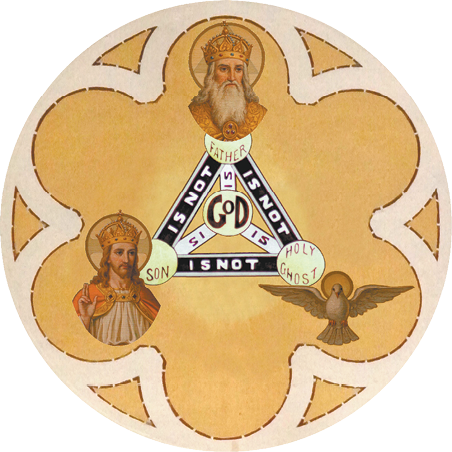
“There is one Person of the Father, another of the Son, and another of the Holy Spirit. . . . The Father is God, the Son is God, and the Holy Spirit is God. And yet there are not three Gods, but one God. . . . And in this Trinity, none is before or after the other; none is greater or less than another; but the whole three Persons are coeternal together and coequal, so that in all things, as is aforesaid, the Unity [one God] in Trinity [three Persons] and the Trinity in Unity is to be worshiped. He, therefore, who will be saved must thus think of the Trinity.”
About the Trinity, believe this, also: God the Father loves you and gave His only begotten Son, Jesus Christ, Who suffered and died to remove your sins; and God the Holy Spirit, Who proceeds from the Father and the Son, has called you by the Gospel—created faith in you—to believe that by the grace of the Triune God you have eternal life. With thankful hearts we sing,
All praise to God the Father be,
All praise, eternal Son, to Thee,
Whom, with the Spirit, we adore
Forever and forevermore.  (TLH 12:5)
“The grace of the Lord Jesus Christ and the love of God and the fellowship of the Holy Spirit be with you all.” (2 Corinthians 13:14)
Amen.

is a retired teacher. He lives in Kasota, Minnesota.