Each month we highlight a hymnwriter who authored one or more of the well-loved hymns that we sing today.
When you get up each morning, what’s your normal routine? For me, while my coffee is brewing, I pray a memorized prayer (not simply recite, but actively pray—trying to keep both mind and heart focused on the meaning of the words and on the One to Whom the prayer is addressed). I pray Martin Luther’s morning prayer.
May I suggest an alternative morning prayer, as well as my hope that all our memorized prayers are genuinely prayed, and not just recited? That alternative prayer is the following:
"Let me be thine forever, Thou faithful God and Lord;
Let me forsake Thee never Nor wander from Thy Word.
Lord, do not let me waver, But give me steadfastness,
And for such grace forever Thy holy name I'll bless."
If a melody was playing in your mind as you read those words, you’ve probably been a Lutheran for a long time. That’s because this prayer is the first stanza of Hymn 334 in The Lutheran Hymnal. It was, in fact, the daily morning prayer of Nikolaus Selnecker, the author of Hymn 334 (as well as anywhere from 120 to 150 others, including Hymns 292 and 321 in TLH).
Today, we remember Selnecker—if at all—primarily as a hymn writer. Certainly, his musical gifts were impressive. For example, he became the organist at the chapel in Kaiserburg in Nürnberg when he was just twelve years old. Lutheran hymns, however, are especially noteworthy for their objective presentation of Biblical truth, so it should not surprise us that this hymnwriter was much better known in his own time as a theologian of the highest caliber, and one with the courage and integrity to uphold pure doctrine even when doing so would cost him dearly.
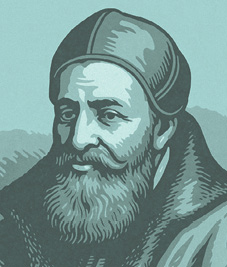
Nikolaus Selnecker 1532-1592
After the death of Luther in 1546, there was much theological turmoil among those calling themselves Lutherans. Over the course of his lifetime, Selnecker lost several pastoral and professorial positions because of his refusal to compromise Biblical truth, especially regarding his opposition to Crypto-Calvinism (the teaching of those who claimed to be Lutheran but secretly accepted and tried to teach Calvinistic doctrine regarding the Lord’s Supper). Although Selnecker was quite gentle and mild in personality, he never wavered theologically. Georg Mylius, a Wittenberg professor, had this to say about Selneker at his funeral: “He was not a weathervane or a rubberneck on the doctrine of the Christian religion, nor was he a reed, which the wind blows here and there, nor a man in impressible clothing, who would let himself be moved to all changes in religious matters for the sake of lordly favor and worldly glory; but he has remained true and faithful to a simply known and confessed truth during his lifetime and continued till his death.”
One of the bedrock theological works of Lutheranism is the Formula of Concord. Nickolaus Selnecker was one of the chief authors of that confession, along with Martin Chemnitz and Johannes Andreae. He also authored 170 theological works, including a multi-volume work of instruction on the chief parts of the Catechism. In that work, emphasizing the characteristic Lutheran emphasis on Law and Gospel rightly divided, he wrote, “[There are] two chief parts of Christian teaching: the Law of God and the doctrine of the Gospel. Where these two parts are rightly brought forth, there is the true Christian Church. There shines the morning dawn, the dayspring from on high, Christ, the radiance of the Father, light of light. But where these two parts are missing, there is also no dawn, but rather darkness, hell, death, the devil, and lies.”
Oh, grant that in Thy holy Word
We here may live and die, dear Lord;
And when our journey endeth here,
Receive us into glory there.
(The Lutheran Hymnal, Hymn 292,
stanza 9 by Nickolaus Selnecker)

is a retired teacher and serves as assistant editor of the Lutheran Spokesman. He lives in Cape Coral, Florida.