
Each month we highlight a hymnwriter who authored one or more of the well-loved hymns that we sing today.
The description of the Lutheran hymn writer Paul Gerhardt in our title is a translation of the Latin inscription beneath a life-sized painting of him that hangs in the church in Germany where he served as pastor.
The reference to Satan reminds us of Job and of how God permitted Satan to afflict him. The expression “Satan’s sieve” calls to mind the words that Peter heard from Jesus on the night before His passion, warning Peter that Satan had desired to have him that he might sift him as wheat (Luke 22:31). For God’s own good and gracious purposes, He permitted Satan to afflict both of these men: Job, by bringing on him catastrophic losses and physical pain and misery; Peter, by luring him into a situation where, moved by fear, he denied Jesus three times.
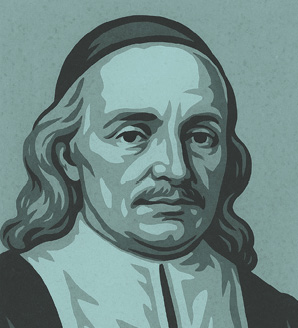
Paul Gerhardt 1607-1676
That inscription beneath Gerhardt’s portrait is no exaggeration. Like Job, Gerhardt suffered great personal losses. Of his six children, one died in infancy, and four were taken in childhood by disease. After all this, his wife died also. Like Peter, Gerhardt was put under severe pressure. His secular ruler tried to force him to sign a document promising that he wouldn’t preach against the unscriptural doctrines of the Reformed. For his refusal, Gerhardt suffered the loss of his position as pastor.
From these sifting experiences of loss, persecution, and hardship came the hymns for which we remember Gerhardt. Of the 123 that he produced, 21 are in The Lutheran Hymnal. These include hymns that we turn to throughout the church year. At Christmas we sing, “All My Heart This Night Rejoices.” (TLH 77) During Lent and Holy Week we sing, “A Lamb Goes Uncomplaining Forth,” (142) and “O Sacred Head, Now Wounded.” (172) At Easter, “Awake My Heart with Gladness.” (192) At Pentecost, “Oh, Enter, Lord, Thy Temple.” (228) We draw strength and encouragement from Gerhardt hymns such as “Jesus, Thy Boundless Love to Me” (349), and “If God Himself Be For Me.” (528)
Gerhardt’s hymns express great joy at the birth of the Savior, His resurrection from the dead, and His outpouring of the Holy Spirit. They exhibit a cheerful and serene confidence in the promises of God’s Word. So much so, that we may be surprised to learn about the trying circumstances under which he composed them. But it was not in spite of the trials of Gerhardt’s life, but because of them, that he wrote such exultant and confident expressions of Christian faith. It was in the loss of earthly blessings that Gerhardt saw clearly that the Christian’s joy and hope are not in these things, but in Christ and His work. It was in the experience of persecution for teaching and standing up for the truth of God’s Word that he learned to long for the promised hope of eternal life. The hymns of Paul Gerhardt are treasures because they teach us to “seek those things which are above, where Christ is, sitting at the right hand of God.” They encourage us to “set your mind on things above, not on things on the earth.” (Colossians 3:1-2 KJV)
Isn’t this just what we need for our lives today? Are we burdened and distracted by either an abundance of material possessions or a desire for these things? Then we need to sing,
I build on this foundation, That Jesus and His blood
Alone are my salvation, The true, eternal good,
Without Him all that pleases Is valueless on earth;
The gifts I owe to Jesus Alone my love are worth. (528:3)
Are our lives today—like those of previous generations—still characterized by troubles and sorrows? Then we need to sing,
Why should cross and trial grieve me? Christ is near With His cheer;
Never will He leave me. Who can rob me of the heaven
That God's Son For my own To my faith hath given? (523:1)

is a retired pastor. He lives in Watertown, South Dakota.