
Each month we highlight a hymnwriter who authored one or more of the well-loved hymns that we sing today.
Martin Luther is well known, even among non-Lutherans, for his work as a reformer and theologian. He was a voluminous writer; composing letters, theological treatises, statements of faith, and more. What is much less well known about Luther is his work with music. From childhood, Luther had a love for music and singing. He often commented on the power of music and that it was a divine gift from God, which could motivate the souls of men. He confidently asserted that the gift of music is good and God pleasing, but bemoaned the fact that spiritually beneficial, God-glorifying music was so rare. He wrote, “I greatly desire that youth, which, after all, should and must be trained in music and other proper arts, might have something whereby it might be weaned from the love ballads and the sex songs and, instead of these, learn something beneficial. . . . I would gladly see all the arts, especially music, in the service of Him who has given and created them.”
This appreciation of music motivated Luther in the work of several German hymnals and a purified liturgy for use in worship. Of all of Luther’s accomplishments, these are among His greatest and most enduring.
Luther enlisted the help of other gifted individuals like Paul Speratus and Justus Jonas, who worked tirelessly to assist Luther in this important endeavor. They translated the best hymns from Latin into German, wrote doctrinally sound modern hymns, and composed powerful melodies to accompany these rich, encouraging, and comforting words. The result of their work was the first German Lutheran hymnal, published in 1524, which contained only eight hymns. Within a few months, another hymnal was published with twenty-six hymns. When Luther died in 1546, over one hundred different hymnals had been published. You can understand why the Lutheran Church was called “the singing church.”
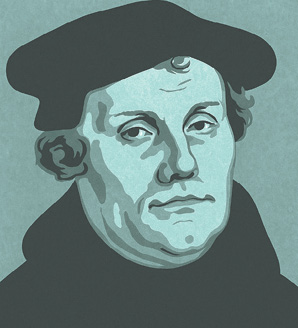
Martin Luther 1483-1546
Luther himself composed only around forty hymns, not nearly as many as others who would follow him. But his hymns were powerful declarations of the faith that brought about the Reformation, and shamelessly pointed to Christ as Savior and the Christian’s only hope.
Of those hymns, “A Mighty Fortress” is known best of all (TLH 262; WS 774; LSB 656, 657). The hymn was written in the late 1520’s during a very dark time in Germany. War, plague, sickness, and religious oppression surrounded the Lord’s church there. In this turmoil, Luther turned to the Lord and the promises found in His Word. He took comfort in the words of the psalmist: “God is our refuge and strength, a very present help in trouble. . . . The nations rage, the kingdoms totter; he utters his voice, the earth melts. The Lord of hosts is with us; the God of Jacob is our fortress.” (Psalm 46:1,6-7) Luther reminds God’s people then and now of the Lord’s power, which is greater than that of every enemy we might face. The old evil foe? Devils eager to devour us? “We tremble not, we fear no ill.” “He can harm us none. He’s judged; the deed is done.” Jesus—the One whom God Himself elected, the Sabaoth Lord, the Valiant One—is on our side, and fights for us! “The Kingdom ours remaineth.”
Luther himself was often comforted as he sang this hymn and was reminded that we are more than conquerors in Christ. He would often invite his coworkers to join him in singing this hymn, saying, “Come, let us sing the 46th Psalm.” This hymn has comforted Christians for almost five hundred years. We still hear Luther encouraging us, inviting us to receive the Lord’s comfort as we “sing the 46th Psalm.”

is a pastor at Immanuel Lutheran Church in Mankato, Minnesota.