
In this series we offer brief introductions to the books of the Bible, including background, authorship, content, and application to the lives of today’s Christians.
Prosecutors are well aware of the threat posed by multiple witnesses. While that sounds counterintuitive, defense attorneys look for inconsistencies in the testimony of multiple witnesses and leverage those inconsistencies to discredit all. Obviously, the threat is eliminated when all witnesses are in perfect agreement, but that is rarely the case when fallible human beings operate from flawed memories.
As we begin an introduction to the four New Testament Gospels, a frequent question is why God the Holy Spirit included four separate accounts of the life of Jesus instead of just one. While man dare not presume to answer for God, not only can we take comfort in the perfect consistency and harmony of the four separate accounts, we can also recognize and appreciate the wealth of information provided from four different perspectives.
Consider, for example, the invaluable truths communicated only through Matthew’s Gospel. It is only from the Gospel of Matthew that we learn of the Magi, the star of Bethlehem, the flight into Egypt, the slaughter of the infants, and why Jesus grew up in Nazareth. Only Matthew recorded the Sermon on the Mount, the miracle of the coin in the fish’s mouth, the Parables of the Weeds (tares) and Wheat, the Hidden Treasure, the Pearl of Great Price, the Unforgiving Servant, the Workers in the Vineyard, the Wise and Foolish Virgins, and the Separation of the Sheep from the Goats. Apart from the Gospel of Matthew, we would know nothing of Peter walking on water or his great confession, upon which Christ founded His Church. We would lack the precision provided in Matthew 18 of exactly how to deal with a fellow Christian who sins against us. We would be poorer for the lack of the clarity of our life’s work provided by Jesus’ Great Commission in chapter 28.
Although Matthew (Levi), like John, does not specifically name himself as the author, he has from antiquity been recognized as such. Matthew’s omission of his authorship is likely a testament to his humility, as is the fact that he refers to himself as “the tax collector” (Matthew 10:3) by which he magnifies God’s grace rather than his own worthiness.
For a variety of reasons, including his frequent reference to Old Testament prophesies, Matthew is believed to have written his Gospel primarily to Jewish readers. He begins by tracing Jesus’ human lineage from Abraham (the progenitor of the Jewish nation) rather than from Adam (as does Luke). Matthew identifies Jesus as “the Son of David,” thereby identifying Him as the rightful heir to the Davidic covenant (2 Samuel 7:12-16). He seems to assume knowledge of the Old Testament on the part of his readers (using words like phylacteries and Gehenna without explanation), and he included the powerful seven-fold rebuke of the scribes and Pharisees (Matthew 23:13-36) which would have had the most obvious relevance to Jewish readers.
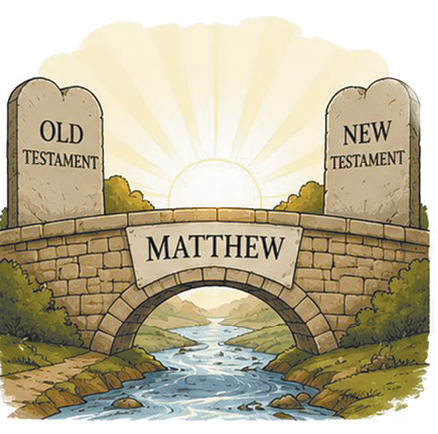
The Gospel of Matthew serves as God’s perfect bridge between the Old and New Testaments by connecting the promises, themes, and expectations of the Old Testament with their fulfillment in the person and work of Jesus Christ. As the first book of the New Testament, Matthew introduces readers to Jesus not as a new or unrelated figure, but as the culmination of God’s covenant purposes revealed throughout the Old Testament. Eleven times Matthew writes “This was to fulfill what was spoken by the prophet,” thereby confirming the central theological truth that Jesus is the promised Messiah Who fulfilled the Law, the Prophets, and the covenant promises of God. The Gospel of Matthew provides divine continuity between God’s work in Israel’s history and His redemptive work through Jesus the Messiah.

is pastor of Saint Paul Lutheran Church in Bismarck, North Dakota.