
Each month we highlight a hymnwriter who authored one or more of the well-loved hymns that we sing today.
Even a broken clock is right twice a day. Though The Lutheran Hymnal contains two shining gems from Nicolai Grundtvig—”Built on the Rock” (467) and “God’s Word Is Our Great Heritage” (283)—to rely on much else Grundtvig penned could only mislead.
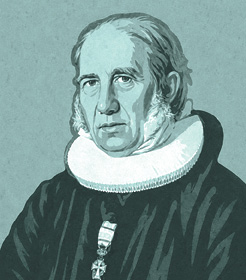
Nicolai F. S. Gruntvig
Young Grundtvig found himself in the middle of a doctrinal triangle. Few conservative pastors contended for old Lutheran doctrine within their erring Danish church. Pietism emphasized subjective feelings over objective doctrine. Rationalism emphasized human reason over Scripture.
His open dissatisfaction with church and society led Grundtvig to rush through his theology coursework by age twenty. It also made reliable employment difficult to find.
In 1825, his personal turmoil birthed what he called his “matchless discovery.” While rationalists argued over what parts of the Bible were true or not, Grundtvig argued that God’s true Word was no text of the Bible but “the living word” of the church’s oral tradition.
Grundtvig claimed Jesus taught His disciples the Apostles‘ Creed Himself, which they then expanded into the four Gospels. Since they learned to repeat the baptismal formula and words of institution aloud before any New Testament book was penned, saving truth is revealed in liturgical mystery: “Only at the bath and at the table, do we truly hear God’s Word among us.”
Notice how “Built on the Rock” craftily blurs the line between the means of grace and their outward adornments:
Here stands the font before our eyesTelling how God did receive us;The altar recalls Christ’s sacrificeAnd what His table doth give us;Here sounds the Word that doth proclaimChrist yesterday, today, the same,Yea, and for aye our Redeemer. (TLH 467:6)
Grundtvig’s “God’s Word” and “our great heritage” are likewise not the inerrant Scriptures true Lutherans confess but an abstract concept of the church’s liturgical life.
God commands us to “mark” false teachers “and avoid them” (Romans 16:17), because when we remain entangled in error, we inevitably end up confessing false things ourselves.
Grundtvig rightly identified the errors of Pietism and Rationalism, but by advocating an answer other than a return to Scripture alone, he allowed the leaven of false teaching to remain. The incarnation replaced the crucifixion as chief saving miracle, and he exalted Norse culture as a manger in which Christian truth nestled.
Grundtvigianism still creeps about today. Missouri Synod podcasts which promote a historic liturgy may offer helpful apologetics against the spiritually corrosive pop-evangelical worship style, but they also seethe with the error I was taught at their seminary that Scripture is only properly understood through a lens of historical creeds and sacramental worship.
Perhaps without this article you’d be none the wiser concerning Grundtvig. To be clear, these two hymns still serve excellent purposes. At our recent church dedication in Aberdeen, South Dakota, we sang “Built on the Rock” with gusto. Prince of Peace in Hecla, South Dakota, sings TLH 283 each Reformation Sunday to its original tune: Ein’ Feste Burg! But if our weekly standards left the burden upon you to interpret the best construction, you would not realize what you were missing until you no longer cared.
Beware the broken clock correct only twice a day: “Test all things; hold fast what is good” (I Thessalonians 5:21 NKJV) The Scriptures, which exhort us to speak “to one another in psalms and hymns” (Ephesians 5:19), hold all our preaching to the highest standard, especially what we sing. Base your staple diet on the very best our Lutheran heritage has to offer, hymns which clearly divide Law and Gospel, proclaim Christ and Him crucified, and your justification through faith in Him, as the finest food for the soul.
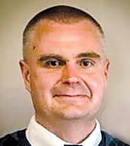
is pastor of Prince of Peace Lutheran Church of Hecla, Zion Evangelical Lutheran Church of Aberdeen, and Redeemer Lutheran Church of Bowdle, South Dakota. He also serves on the CLC Board of Missions.