Every other month we get an update on what’s been happening recently at our Immanuel Lutheran High School, College and Seminary in Eau Claire, Wisconsin.
Currently in the CLC, there are nine pastoral vacancies affecting ten congregations, most of which do not have a resident pastor. With one-third of CLC pastors now aged 60 or older, the growing shortage of ministers became a focal point of the 2024 and 2026 CLC Conventions. At the recent convention in June, a lay training program was approved with the goal of providing more immediate, near-term help for laymen serving in these vacant congregations (see “EMT Program” page 6.) But the long-term solution remains the same: that our church body continues to seek God’s blessing in finding, supporting, training, and calling the next generation of CLC pastors.
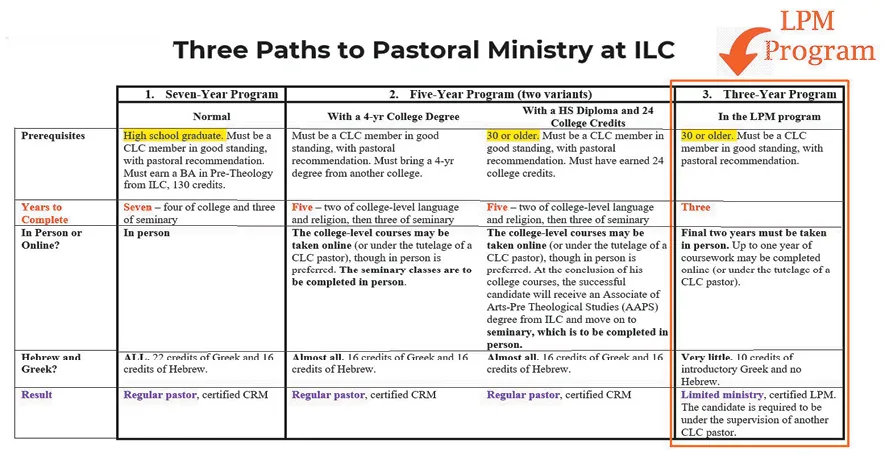
Traditionally, this has involved Immanuel Lutheran College and Immanuel Lutheran Seminary, which offer a seven-year program for students recently graduated from high school, a five-year program for students with credits from other institutions, and a three-year program that involves taking college and seminary courses at the same time. This article is about the three year, Limited Public Ministry (LPM) program, reflected in the rightmost column of the chart below.
The main difference between the three-year program and the other two is expressed in the name Limited Public Ministry. The graduate of the three-year program has a limited amount of training that prepares him for a limited amount of pastoral ministry; and another key limit is the expectation that he serve under the continual supervision of a CLC pastor, regardless of where he is called.
The three-year LPM training aims at producing graduates capable of reading sermons and leading Sunday worship, teaching Bible and confirmation classes, visiting the sick and shut-in, and carrying out other typical pastoral duties. Thus, the LPM graduate could serve as assistant pastor to a large congregation. An LPM graduate could help a pastor of multiple parishes provide a weekly worship schedule more suited to the various congregations’ needs. An LPM graduate would also be trained for full-time ministry at a smaller congregation, or an evangelism ministry at a CLC preaching station, or a chaplain ministry to shut-ins, hospitalized members, and those in hospice care. The training aims at equipping the called worker for full-time worship, teaching, counseling, and evangelism roles, but always under the guidance and supervision of a fellow CLC pastor.
The minimum enrollment age for the LPM program was recently reduced from thirty-five to thirty. This is also true of the five-year program if the enrolling student has earned at least twenty-four credits of post-secondary education at another institution. Both five-year programs involve two years of college courses, including Greek and Hebrew, and all the seminary courses. The Limited Public Ministry program, on the other hand, combines pre-theology college courses and most of the seminary courses in such a way that Old Testament Hebrew is left out and learning New Testament Greek is greatly reduced.
For more information on any of the three pastoral ministry programs at Immanuel, please contact Academic Dean Paul Naumann (paul.naumann@ilc.edu), or visit the seminary page on the ILC website (ILC.edu). All ministry students enrolled full-time, including those in the Limited Public Ministry program, are eligible for substantial annual tuition grants and other financial aid. Applicants who have served in the military are likewise eligible for veterans’ benefits as outlined on pages 5-6 in the ILC college catalog.
Regardless of the program pursued, it is always our prayer that “the Lord of the harvest send out laborers into His harvest” (Matthew 9:38) through the pastoral students trained at Immanuel and the CLC congregations who, God willing and directing, will one day call them.
is a professor at Immanuel Lutheran College in Eau Claire, Wisconsin.