
Each month we highlight a hymnwriter who authored one or more of the well-loved hymns that we sing today.
As you may have realized from previous articles in this series, some of our Lutheran hymn writers have rather dramatic and even grievous “back stories” to their lives. Paul Gerhardt, Johann Heermann, Nikolaus Selnecker, Philipp Nicolai, and of course Martin Luther all stood fast in the pure doctrine of the Gospel against powerful opposition to the truth, and emerged victorious from both personal suffering and professional ordeals.
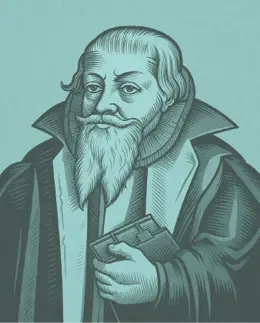
The subject of this month’s article, Bartholomäus Ringwalt (1532 – 1599 or 1600), did not suffer those tribulations. He was the pastor of two parishes before becoming the pastor of Langenfeld near Sonnenburg, Brandenburg. Compared to those other hymnwriters, Ringwalt was blessed to live a relatively trouble-free life. The Peace of Augsburg signed in 1555 meant that Ringwalt, living in the Lutheran territory of Brandenburg, enjoyed legal protection for his ministry without interference from the (Catholic) Holy Roman Empire. The devastating Thirty-Years War, which brought death, famine, and disease throughout central Europe, started in 1618—nearly two decades after Ringwalt’s death. So it was that in the relatively peaceful Lutheran stronghold of Brandenburg, Pastor Ringwalt became an influential writer of didactic (teaching) poetry, as well as at least 165 hymns. We have two of those hymns, “O Holy Spirit, Grant Us Grace” (TLH 293) and “The Day Is Surely Drawing Near” (TLH 611) in The Lutheran Hymnal.
Although the lack of personal and professional drama in the “back story” to Ringwalt’s life is unlikely to make him the subject of a Hollywood “biopic,” the edifying theological content of his poems and hymns, and especially their applicability to our lives as 21st Century American Christians, certainly express material worthy of our consideration.
Many of Ringwalt’s poems and hymns focus on eschatology (the branch of theology dealing with the end times). In those, Ringwalt exhorts Christians to always remember that in this life, we are merely pilgrims on our way Home. He warns about being so focused on temporal matters that we neglect matters of infinite importance and eternal consequence. Given the ease and affluence of our lives as Americans today, this is an important truth for us to bear in mind. Consider, for example, Hymn 611. In Verse 4, we are reminded this about the Day of Judgment:
Then woe to those who scorned the Lord
And sought but carnal pleasures,
Who here despised His precious Word
And loved their earthly treasures!
With shame and trembling they will stand
And at the Judge's stern command
To Satan be delivered.
Verses 1-3 set the stage for this dire warning, and—if the hymn ended with Verse 4—it well might be considered to lack a Gospel focus. However, having proclaimed Law in Verses 1-4, Ringwalt then proceeds in Verse 5 to soothe our hearts with the Gospel assurance of the free forgiveness of all our sins, apart from any merit or worthiness in us, solely because of the perfect life and vicarious death of our Savior, Jesus Christ:
O Jesus, who my debt didst pay
And for my sin wast smitten,
Within the Book of Life, oh, may
My name be also written!
I will not doubt; I trust in Thee
rom Satan Thou hast made me free
And from all condemnation.
Antinomianism, such as found in the most liberal churches in our day, avoids proclaiming the stern truth of God’s Law. Legalism, such as is common in some denominations, preaches the opposite error: works righteousness. Ringwalt walked the Biblical line between those two opposite errors. His poems and hymns declare the Law in all its sternness, and the Gospel in all its sweetness. May our lives always be blessed with such faithful teaching.

is a retired teacher and serves as assistant editor of the Lutheran Spokesman. He lives in Cape Coral, Florida.