
“And all the prophets prophesied so and said, ‘Go up to Ramoth-gilead and triumph. The Lord will give it into the hand of the king.’ And the messenger who went to summon Micaiah said to him, ‘Behold, the words of the prophets with one accord are favorable to the king. Let your word be like the word of one of them, and speak favorably.’ But Micaiah said, ‘As the Lord lives, what my God says, that I will speak.'” (2 Chronicles 18:11-13)
A “yes man” is someone who always agrees with a person higher in rank. We sometimes see the rich and famous surround themselves with an entourage of “yes men.” It feels good when everyone encourages you in everything you do. It feels good to feel right. But what if you aren’t right?
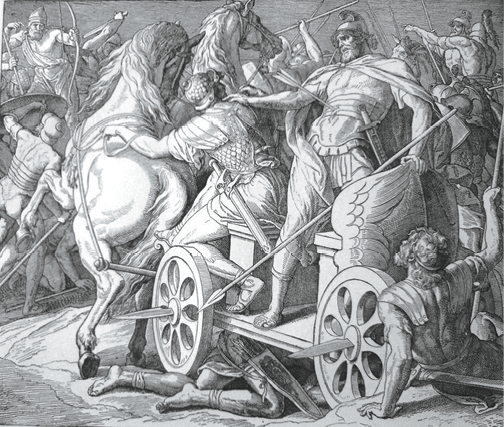
Death of King Ahab 1870 by Julius Schnorr
In 2 Chronicles 18, we read how the king of Judah, Jehoshaphat; and the king of Israel, Ahab, allied themselves against the Syrians in Ramoth-gilead. When King Jehoshaphat requested that Ahab inquire of his prophets whether they would triumph in battle, a false prophet name Chenaanah and four hundred of his cohorts prophesied favorably and unanimously, “Go up to Ramoth-Gilead and triumph. The Lord will give it into the hand of the king.” (verse 11) But Jehoshaphat could evidently sense the desire of these prophets to simply tell Ahab what he wanted to hear, so he requested a second opinion from another prophet. Ahab replied, “There is yet one man by whom we may inquire of the Lord, Micaiah, son of Imlah; but I hate him, for he never prophesies good concerning me, but always evil.” (2 Chronicles 18:7)
When the other prophets came to summon Micaiah, they pleaded that he would join his voice to theirs and speak only of victory. But Micaiah answered that he was constrained to speak only what God gave him to speak. Even after that, though, Micaiah did speak favorably at first in the presence of the kings. But even Ahab could tell that the prophet was withholding the truth. So, Micaiah finally delivered God’s Word to the kings: “I saw all Israel scattered on the mountains, as sheep that have no shepherd” (verse 16) (thereby foretelling Ahab’s defeat and death). And because he disobeyed the king and spoke the Lord’s truth, Micaiah was thrown in prison.
The sad reality is that most of the people you encounter will not thank you for speaking the truth, especially during this Lenten season. You might recall how Pontius Pilate even questioned the existence of truth while presiding over Christ’s trial, asking, “What is truth?” (John 18:38) God’s Word, which alone stands as the source of all that is true in this world, condemns each one of us as sinners. It is the iniquity we are born into and which we commit daily that condemns mankind to eternal death and hell. But this is only one part of the truth.
The other, far more comforting truth of Lent is that Christ Jesus came into the world to redeem sinners just like us. “In him we have redemption through his blood, the forgiveness of our trespasses, according to the riches of his grace.” (Ephesians 1:7) People will seldom thank you for holding up the mirror of God’s Law, for it shows us the true extent of our transgressions. But such truth is necessary. If we have no sin, what did Jesus die for? From what has He saved us? The Law must be preached in order to proclaim the saving truth of Jesus Christ: the Lamb of God Who takes away the sins of the world! May the Holy Spirit endow us with the courage of the prophets to speak nothing more nor less than the truth our loving God has revealed to us for our instruction in righteousness.

is a pastor at Messiah Lutheran Church of Eau Claire, Wisconsin.