
Each month we highlight a hymnwriter who authored one or more of the well-loved hymns that we sing today.
Philipp Nicolai was born in Germany in 1556, ten years after the death of Martin Luther. He did not live through the tumultuous years of the Reformation but inherited the rich theology of the Lutheran Church. He was like many of us, who were not alive when our church body was founded, but who are inheritors of a deep theological history and tradition. That is not to suggest Nicolai’s life was easy. In many ways it was as difficult as the life of Martin Luther and his contemporaries.
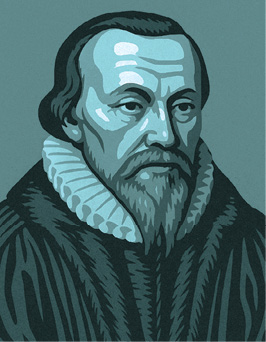
Philipp Nicolai 1556-1608
Nicolai fought a theological war on two fronts. First, he lived during the years of what has been called the “Counter-Reformation.” During these years the Roman Catholic Church was working hard to reclaim people from Lutheranism. Nicolai resigned his first call due to pro-Catholic opposition. In addition to these challenges, he was also involved in fierce battles with the followers of John Calvin who rejected the real presence of Christ in the Lord’s Supper. As a result of his defense of the Biblical teaching on the Sacrament, he was banned from preaching for a time and was strongly opposed by Calvinists throughout his pastoral ministry.
From a young age Nicolai displayed both an interest in and a gift for poetry—a gift which he developed throughout his life. Those whom he served knew him as a caring and loving shepherd and as a gifted and eloquent preacher. While he used this gift to comfort those burdened by sin, he was also a staunch defender of God’s Word of truth. He was also known to direct words of warning and judgment against those who rejected the truths of God’s Word, leading many people to despise and even hate Nicolai.
His two most valuable works are considered by some to be the greatest Lutheran hymns of all time. His hymn, “Wake, Awake, for Night Is Flying” (TLH 609; LSB 516) has been called the “King of the Chorales,” and his hymn “How Lovely Shines the Morning Star” (TLH 343; LSB 395) the “Queen of the Chorales.” Both of these hymns reveal Nicolai as the compassionate shepherd and a powerful defender of God’s Word. For example, in “How Lovely Shines the Morning Star” Nicolai
- rightly describes both the person and work of Jesus: “True Son of God and Mary’s Son, Thou highborn King of ages!” (verse 2)
- beautifully points to the Word as the means by which God brings us to faith and gives us salvation: “Thy blest Gospel’s saving power my raptured soul engages. . . . Heav’nly manna, tasting, eating” (verse 2)
- faithfully defends the Real Presence declaring, “Thy body and Thy blood, afford my soul its dearest treasure.” (verse 4)
- expresses the joy the Christian has even in the trials of this life: “Thy Son hath made a friend of me, and when in spirit Him I see, I joy in tribulation.” (verse 5)
- and joyfully proclaims his confidence in eternal life with Jesus: “And Thou at length—O glorious grace!—wilt take me to that holy place, the home of joys supernal,” (verse 7)
The life of Nicolai reminds us that the work of reformation is ongoing through every generation, not just a past event in the lives of those who have come before us. Every generation, whether they formed a church body out of faithfulness to the truth, or whether they have inherited one from their parents, is called to stand for and preserve God’s truth.
Philipp Nicolai stands as a faithful second-generation Lutheran who made the confession of a previous generation his own. He had the courage to faithfully proclaim both God’s judgment on sin and His deep mercy for sinners through the work of Jesus. Are you willing to follow in his steps?

is a pastor at Immanuel Lutheran Church in Mankato, Minnesota.