


In this series we offer brief introductions to the books of the Bible, including background, authorship, content, and application to the lives of today’s Christians.
Paul’s second letter to Timothy, his protégé (see the September 2025 Lutheran Spokesman), is classified with 1 Timothy and Titus as one of the “pastoral epistles.” That makes sense—like the other two, 2 Timothy is full of instruction and counsel relating to Timothy’s work there in Ephesus. But in striking ways this letter is different. While the first letter to Timothy was warm and familiar, it was still very much a business document; it had a formal tone with detailed, practical instructions for Timothy in organizing the Gospel work in Asia Minor. One could imagine it being used as a blueprint for ministry by any church. But this second letter is deeply poignant. It still contains valuable instruction for a pastor and a church, but there is something more; it is, as the eighteenth-century commentator Johannes Bengel put it, “Paul’s last will and testament.”
Paul’s circumstances at the time of writing are not completely clear, because there are no references in the New Testament that reveal what happened to lead up to this point. The Acts of the Apostles ends with Paul’s two-year imprisonment in Rome, after which he must have been released to continue his work—perhaps traveling to Spain, as he had hoped (Romans 15:24), and/or returning eastward to encourage the churches planted on earlier mission journeys. But at some point, he was arrested for his Christian preaching, and this time was again imprisoned in Rome, but under much more severe circumstances. He had undergone one court hearing, receiving a partial reprieve (4:16-17), but fully expected that this matter would end with his martyrdom: “for I am already being poured out as a drink offering, and the time of my departure is at hand.” (2 Timothy 4:6)
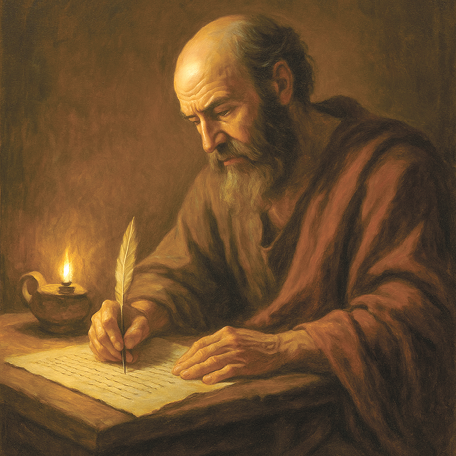
So Paul had much on his heart to share with Timothy, his “beloved son.” (1:2) He hoped that Timothy, still laboring in Ephesus, might be able to “come before winter” (when sailing in the Mediterranean became risky, 4:21), but just in case, this letter would have to do.
Truly, by the work of the Holy Spirit, this letter has done well. The letter is forward-looking, almost prophetic, with Paul commenting on what is to come for himself (4:6-16), for Timothy (3:10-17), and for the Church in general (3:1-9); but it is also warmly reflective, tenderly recalling Timothy’s upbringing, taught on the knees of his mother Eunice and grandmother Lois (1:5) who so effectively imparted to him “from childhood . . . the Holy Scriptures.” (3:15)
But as warm and powerful as those memories are, Paul is not adrift in nostalgia. He is focused on building up this young servant of Christ for his faith and work. This letter has a clear purpose: he seeks to fortify Timothy, and through him, the next generation of ministers of Christ. The key, Paul says, is faithful ministry of the Word: “hold fast the pattern of sound words which you have heard from me, in faith and love which are in Christ Jesus.” (1:13) Therefore, he counsels, “preach the word. Be ready in season and out of season. Convince, rebuke, exhort, with all longsuffering and teaching.” (4:2) The young pastor must avoid “foolish and ignorant disputes” (2:23), and rather “be diligent to present yourself approved to God, a worker who does not need to be ashamed, rightly dividing the word of truth.” (2:15)
In the hymn “Fight the Good Fight with All Thy Might” (TLH 447), we hear an echo of Paul’s bracing valedictory: “I have fought the good fight, I have finished the race, I have kept the faith. Finally, there is laid up for me the crown of righteousness, which the Lord, the righteous Judge, will give to me on that Day, and not to me only but also to all who have loved His appearing.” (4:7-8)
It is hard to imagine any reader who could contemplate the inspiring, inspired words that Paul shares here, without likewise loving His (Christ’s) appearing.

is a former pastor who now teaches English at the University of Wisconsin-Stout. He makes his home in Eau Claire, Wisconsin.